

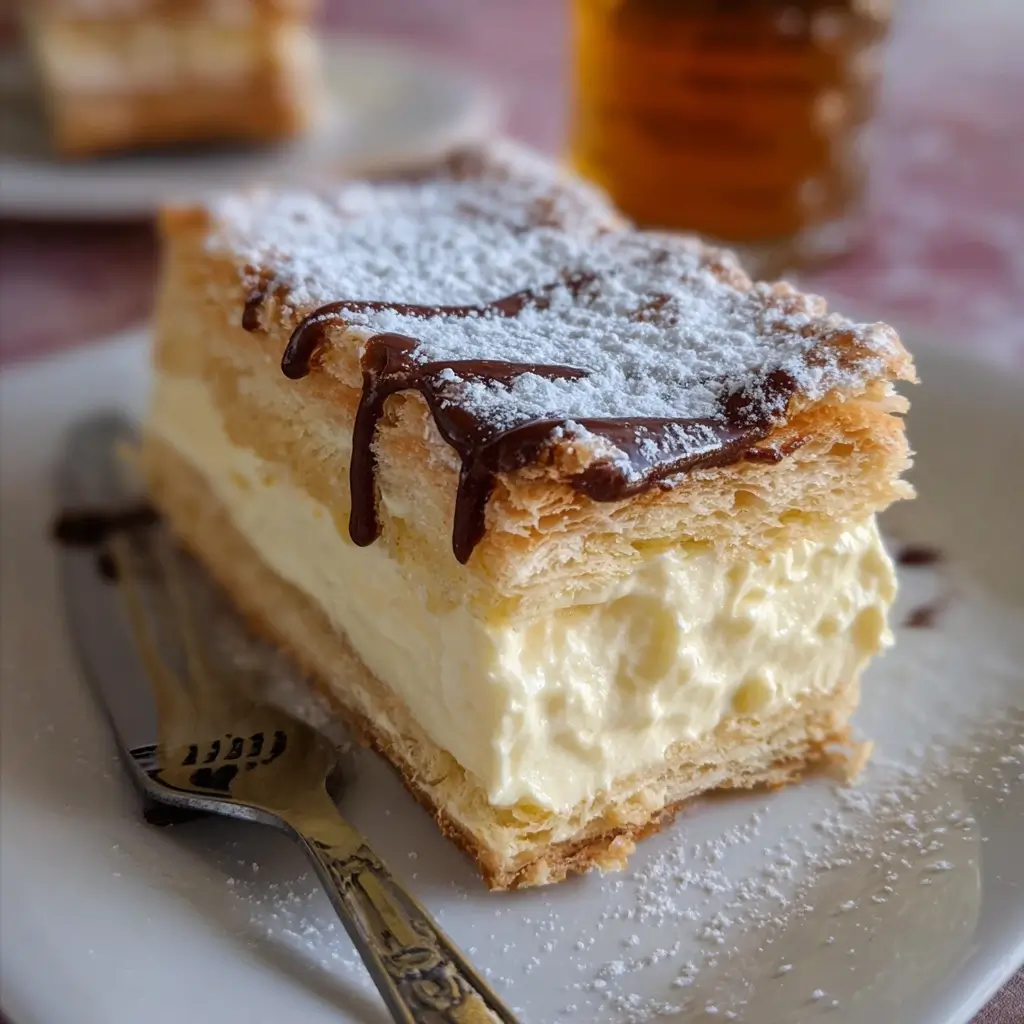
The first time I encountered a true Cremeschnitte, it wasn’t in a fancy Viennese Konditorei, but at a bustling family gathering. My great-aunt, a woman whose culinary prowess was legendary, unveiled this towering masterpiece of golden pastry and quivering, pale-yellow cream. The air filled with a delicate vanilla perfume, and a hush fell over the room. As I took my first bite, the world momentarily paused. The crisp, shattering layers of puff pastry gave way to the most impossibly smooth, cool, and richly vanilla-infused custard I had ever tasted. It wasn’t just sweet; it was a complex symphony of textures and subtle flavors. That day, Cremeschnitte (or “Krempita” as she often called it, nodding to her Balkan roots) became more than just a dessert; it became a cherished memory, a symbol of celebration and shared joy. My family still talks about her Cremeschnitte, and attempting to recreate it has been a delightful journey. This recipe is the culmination of many trials, aiming to capture that perfect balance of flaky, creamy, and utterly irresistible. It’s a showstopper, yes, but with a little care and attention to detail, it’s surprisingly achievable in your own kitchen, ready to create new memories for your loved ones. The oohs and aahs when you present this are, quite frankly, worth every moment spent in its creation.
Ingredients
This recipe aims for a classic, luxurious Cremeschnitte. Using high-quality ingredients will make a noticeable difference in the final taste and texture.
For the Puff Pastry:
- 2 sheets (approx. 500g or 1.1 lbs total) all-butter puff pastry, thawed if frozen (each sheet roughly 10×15 inches / 25×38 cm)
- 1-2 tablespoons granulated sugar (optional, for sprinkling on pastry)
For the Vanilla Custard Cream:
- 4 cups (1 liter) whole milk
- 1 ¾ cups (350g) granulated sugar
- 1 cup (120g) cornstarch
- ½ cup (60g) all-purpose flour
- 10 large egg yolks
- ½ cup (113g / 1 stick) unsalted butter, cut into small pieces and at room temperature
- 2 tablespoons pure vanilla extract (or 1 vanilla bean, split and scraped, plus 1 tablespoon extract)
- Pinch of salt
- Optional: 2 tablespoons dark rum or brandy (for a more traditional European flavor)
- Optional: Zest of 1 lemon (adds a subtle brightness)
For the Topping:
- ½ cup (60g) powdered sugar, for dusting
- Optional Glaze (instead of powdered sugar):
- 1 cup (120g) powdered sugar
- 2-3 tablespoons milk or lemon juice
- ½ teaspoon vanilla extract
Instructions
Creating the perfect Cremeschnitte involves several key stages: baking the pastry, preparing the rich custard, assembling the layers, and crucial chilling. Take your time with each step for the best results.
1. Prepare and Bake the Puff Pastry:
* Preheat your oven to 400°F (200°C). Line two large baking sheets with parchment paper.
* Carefully unroll the thawed puff pastry sheets. If they are not the desired size (roughly matching a 9×13 inch / 23×33 cm baking pan for assembly later), you can gently roll them slightly.
* Place one sheet of puff pastry on each prepared baking sheet.
* Using a fork, generously prick the surface of both pastry sheets all over (docking). This prevents them from puffing up too dramatically and unevenly.
* Optional Sugar Crust: Lightly sprinkle one or both pastry sheets with granulated sugar for an extra crispy, caramelized finish.
* Place another sheet of parchment paper on top of each pastry sheet, and then place another baking sheet (or oven-safe weights) on top. This helps the pastry bake flat and evenly.
* Bake for 15-20 minutes with the weights on. Then, carefully remove the top baking sheet and parchment paper.
* Continue baking for another 10-15 minutes, or until the pastry is a deep golden brown, crisp, and fully cooked. Keep a close eye on it, as puff pastry can burn quickly towards the end.
* Once baked, remove the pastry from the oven and let it cool completely on a wire rack.
* After cooling, if necessary, carefully trim the edges of one of the pastry sheets with a sharp serrated knife to fit snugly into the bottom of a 9×13 inch (23×33 cm) baking pan. This will be your base. The second sheet can be pre-cut into squares or rectangles (matching your desired serving size) before assembly, or left whole to be placed on top and cut later (which is trickier but traditional). For easier serving, pre-cutting the top layer is recommended.
2. Prepare the Vanilla Custard Cream:
* In a small bowl, whisk together the cornstarch, all-purpose flour, and about ½ cup (100g) of the granulated sugar. Add about ½ cup of the cold milk and whisk until you have a smooth, lump-free slurry. Set aside.
* In a separate large bowl, whisk the egg yolks with the remaining 1 ¼ cups (250g) of granulated sugar and the pinch of salt until pale and slightly thickened. This process is called “ribboning” and incorporates air.
* Gradually whisk the cornstarch-flour slurry into the egg yolk mixture until fully combined and smooth.
* In a large, heavy-bottomed saucepan, heat the remaining 3 ½ cups of milk with the vanilla bean (if using, split and scraped, add both pod and seeds) and lemon zest (if using) over medium heat. Bring it just to a simmer – don’t let it boil vigorously. Small bubbles should appear around the edges.
* Temper the Eggs: This is a crucial step to prevent the eggs from scrambling. Slowly pour about 1 cup of the hot milk into the egg yolk mixture, whisking constantly and vigorously. Then, pour another cup of the hot milk into the egg mixture, still whisking.
* Now, pour the tempered egg yolk mixture back into the saucepan with the remaining hot milk.
* Cook over medium-low heat, whisking constantly and thoroughly, especially around the bottom and edges of the pan, to prevent scorching and lumps.
* Continue to cook, whisking, until the custard thickens considerably and comes to a gentle boil. You should see large bubbles “plopping” on the surface. Cook for another 1-2 minutes once it starts bubbling, still whisking, to ensure the cornstarch and flour are fully cooked and the custard is stable. It should be very thick.
* Remove the saucepan from the heat. If using a vanilla bean pod, remove it now.
* Immediately add the room temperature butter pieces to the hot custard and whisk until the butter is completely melted and incorporated, making the custard glossy and smooth.
* Stir in the vanilla extract and rum/brandy (if using).
* Strain the Custard (Optional but Recommended): For the smoothest possible custard, strain it through a fine-mesh sieve into a clean bowl. This will remove any potential small lumps or bits of cooked egg.
* Cover the surface of the custard directly with plastic wrap, pressing it down gently to prevent a skin from forming as it cools. Allow it to cool slightly at room temperature for about 20-30 minutes, stirring occasionally if you didn’t cover it directly. It should still be warm when assembling.
3. Assemble the Cremeschnitte:
* Line your 9×13 inch (23×33 cm) baking pan with parchment paper, leaving an overhang on two sides to make it easier to lift the Cremeschnitte out later. If your pan has a removable bottom, that’s even better.
* Place the trimmed, solid sheet of baked puff pastry into the bottom of the prepared pan.
* Pour the still-warm (but not piping hot) vanilla custard cream over the pastry base. Spread it evenly using an offset spatula. Work quickly as the custard will begin to set.
* Carefully place the second sheet of puff pastry on top of the custard. If you pre-cut this layer, arrange the pieces neatly over the custard. If using a whole sheet, place it gently on top.
* Lightly press down on the top pastry layer to ensure it adheres to the custard.
4. Chill Thoroughly:
* Cover the pan loosely with plastic wrap (don’t let it touch the top pastry too much or it can make it soggy).
* Refrigerate the Cremeschnitte for at least 6 hours, but preferably overnight (8-12 hours). This extended chilling time is crucial for the custard to set completely, allowing for clean slices. Do not rush this step!
5. Cut and Serve:
* Once fully chilled and set, carefully lift the Cremeschnitte out of the pan using the parchment paper overhangs. Place it on a cutting board.
* Generously dust the top pastry layer with powdered sugar using a fine-mesh sieve.
* Cutting: This is the trickiest part. For the cleanest cuts:
* If you didn’t pre-cut the top pastry layer: Use a very sharp, long serrated knife. Some people find it helpful to warm the knife in hot water and wipe it dry between cuts. Saw gently; don’t press down hard, or the custard will squish out.
* If you did pre-cut the top layer: Simply use your sharp knife to cut through the custard and bottom pastry layer, following the lines of your pre-cut top pieces.
* Cut into squares or rectangles of your desired size. Wipe the knife clean between cuts for the neatest presentation.
* Serve immediately, chilled.
Nutrition Facts
- Servings: This recipe typically yields 12-16 generous servings, depending on how large you cut the pieces.
- Calories per serving (approximate): 350-450 calories.
- Disclaimer: This is an estimate. Actual calories will vary based on specific ingredients used (especially the type of puff pastry and fat content of milk), and the final serving size. Cremeschnitte is an indulgent dessert, best enjoyed in moderation as part of a balanced diet.
Preparation Time
Understanding the time commitment helps in planning:
- Active Preparation Time: Approximately 1 hour to 1 hour 30 minutes (includes preparing pastry for baking, making the custard, and assembly).
- Puff Pastry Baking Time: Approximately 25-35 minutes.
- Puff Pastry Cooling Time: At least 30-60 minutes.
- Custard Cooling (slight, before assembly): 20-30 minutes.
- Chilling Time (Crucial): Minimum 6 hours, preferably 8-12 hours (overnight is best).
- Total Time (from start to ready-to-serve): Approximately 8 to 14 hours (mostly inactive chilling time).
Planning to make Cremeschnitte a day before you intend to serve it is highly recommended.
How to Serve
Cremeschnitte is elegant on its own but can be enhanced with simple accompaniments. Here are some ideas:
- Classic Presentation:
- Serve chilled, freshly cut into neat squares or rectangles.
- Ensure a generous dusting of powdered sugar on top just before serving.
- With Fresh Fruit:
- A side of fresh berries (strawberries, raspberries, blueberries) provides a lovely color contrast and tartness to balance the sweetness.
- A few slices of kiwi or mango can also be delightful.
- With a Coulis:
- Drizzle a vibrant raspberry or strawberry coulis around or partially over the slice for an extra touch of fruitiness and visual appeal.
- A passion fruit coulis would also offer a wonderful tropical tang.
- Beverage Pairings:
- Coffee: A strong espresso, a creamy cappuccino, or a simple black coffee cuts through the richness beautifully.
- Tea: A cup of black tea (like Earl Grey or English Breakfast) or a light herbal tea (like chamomile or mint) complements the dessert well.
- Dessert Wine: A late-harvest Riesling or a Moscato d’Asti can be a sophisticated pairing for a special occasion.
- Plate Presentation:
- Use clean, elegant dessert plates.
- A small mint sprig can add a touch of green.
- If using a coulis, artfully swirl it on the plate before placing the Cremeschnitte.
- Occasions:
- Perfect for special celebrations: birthdays, anniversaries, holidays.
- An impressive dessert for dinner parties.
- A luxurious treat for an afternoon tea gathering.
Additional Tips (5 tips)
- Puff Pastry Perfection: Don’t skip docking (pricking) the pastry. This, along with baking with weights initially, ensures a flat, even, and crispy base and top. All-butter puff pastry offers the best flavor, but good quality regular puff pastry will also work. Bake until it’s a deep golden brown; underbaked pastry will be soft and unappealing.
- Lump-Free Custard is Achievable: The key is to whisk constantly, especially when adding the hot milk to the eggs (tempering) and while the custard cooks on the stove. Don’t let the heat get too high too quickly. Straining the custard through a fine-mesh sieve after cooking is an extra step that guarantees silky smoothness.
- The Chill is Non-Negotiable: Patience is paramount. The long chilling period (ideally overnight) is essential for the custard to fully set. If you try to cut it too soon, you’ll have a messy, oozing situation. A well-chilled Cremeschnitte will slice cleanly and hold its shape.
- Mastering the Cut: Pre-cutting the top layer of puff pastry before assembling can make serving significantly neater and easier. If you opt for cutting after chilling, use a long, thin, very sharp serrated knife. Dip the knife in hot water and wipe it clean between each cut. Use a gentle sawing motion rather than pressing down hard.
- Storage and Freshness: Cremeschnitte is best enjoyed within 1-2 days of making. Store it covered in the refrigerator. While it will still be edible on day 3, the puff pastry will start to absorb moisture from the custard and lose its crispness. For optimal texture, serve it as fresh as possible after the chilling period.
FAQ Section (5 Q/A)
Q1: My puff pastry didn’t get crispy, or it got soggy quickly. What went wrong?
- A1: Several factors could be at play. Ensure your puff pastry was baked thoroughly until deep golden brown and dry to the touch; underbaking leads to a soft texture. Cool it completely before adding the warm custard. Also, if the custard is too hot when poured, it can steam the pastry. While some softening of the bottom layer is inevitable over time, proper baking and cooling helps. Finally, ensure your oven temperature is accurate.
Q2: My custard is runny and didn’t set properly. How can I fix this for next time?
- A2: This usually means the custard wasn’t cooked long enough or at a high enough (gentle boil) temperature for the cornstarch and flour to fully activate and thicken. You must bring the custard to a gentle boil, where you see large bubbles “plopping” on the surface, and cook it, whisking constantly, for a full 1-2 minutes past this point. Also, ensure you used the correct amounts of thickeners (cornstarch and flour). Insufficient chilling time can also lead to a seemingly runny custard.
Q3: Can I make Cremeschnitte with a different flavored custard?
- A3: Absolutely! While vanilla is classic, you can experiment. Chocolate Cremeschnitte is delicious (add cocoa powder or melted chocolate to the custard base). Lemon or orange zest and juice can create a citrusy version. You could even try a coffee-flavored custard by dissolving instant espresso powder in the warm milk. Just be mindful of how additional liquids might affect the custard’s setting ability; you might need to slightly adjust thickeners.
Q4: Is it possible to make a smaller batch of Cremeschnitte?
- A4: Yes, you can halve the recipe and assemble it in a smaller pan, like an 8×8 inch square pan. You’ll need to adjust puff pastry usage accordingly (one sheet might be enough, cut in half). Keep an eye on baking times for smaller pastry pieces and cooking time for a smaller volume of custard, though the principles remain the same.
Q5: What’s the difference between Cremeschnitte, Krempita, and Mille-Feuille?
- A5: They are all related custard/cream and puff pastry desserts.
- Cremeschnitte (German/Austrian): Typically features two layers of puff pastry sandwiching a thick vanilla custard, often just dusted with powdered sugar.
- Krempita (Balkan/Slavic): Very similar to Cremeschnitte, often identical in structure and taste. The name varies by region (e.g., Kremsnita in Croatia, Kremna Rezina in Slovenia).
- Mille-Feuille (French, meaning “thousand sheets/leaves”): Usually has three layers of puff pastry alternating with two layers of pastry cream (crème pâtissière, which is similar but often richer/denser than Cremeschnitte custard). The top is traditionally decorated with a specific marbled icing pattern (fondant and chocolate).
While they share core components, the number of layers, specific custard richness, and topping styles can differentiate them.

Cremeschnitte Recipe
Ingredients
For the Puff Pastry:
-
- 2 sheets (approx. 500g or 1.1 lbs total) all-butter puff pastry, thawed if frozen (each sheet roughly 10x15 inches / 25x38 cm)
-
- 1–2 tablespoons granulated sugar (optional, for sprinkling on pastry)
For the Vanilla Custard Cream:
-
- 4 cups (1 liter) whole milk
-
- 1 ¾ cups (350g) granulated sugar
-
- 1 cup (120g) cornstarch
-
- ½ cup (60g) all-purpose flour
-
- 10 large egg yolks
-
- ½ cup (113g / 1 stick) unsalted butter, cut into small pieces and at room temperature
-
- 2 tablespoons pure vanilla extract (or 1 vanilla bean, split and scraped, plus 1 tablespoon extract)
-
- Pinch of salt
-
- Optional: 2 tablespoons dark rum or brandy (for a more traditional European flavor)
-
- Optional: Zest of 1 lemon (adds a subtle brightness)
For the Topping:
-
- ½ cup (60g) powdered sugar, for dusting
-
- Optional Glaze (instead of powdered sugar):
-
- 1 cup (120g) powdered sugar
-
- 2–3 tablespoons milk or lemon juice
-
- ½ teaspoon vanilla extract
-
- Optional Glaze (instead of powdered sugar):
Instructions
1. Prepare and Bake the Puff Pastry:
* Preheat your oven to 400°F (200°C). Line two large baking sheets with parchment paper.
* Carefully unroll the thawed puff pastry sheets. If they are not the desired size (roughly matching a 9×13 inch / 23×33 cm baking pan for assembly later), you can gently roll them slightly.
* Place one sheet of puff pastry on each prepared baking sheet.
* Using a fork, generously prick the surface of both pastry sheets all over (docking). This prevents them from puffing up too dramatically and unevenly.
* Optional Sugar Crust: Lightly sprinkle one or both pastry sheets with granulated sugar for an extra crispy, caramelized finish.
* Place another sheet of parchment paper on top of each pastry sheet, and then place another baking sheet (or oven-safe weights) on top. This helps the pastry bake flat and evenly.
* Bake for 15-20 minutes with the weights on. Then, carefully remove the top baking sheet and parchment paper.
* Continue baking for another 10-15 minutes, or until the pastry is a deep golden brown, crisp, and fully cooked. Keep a close eye on it, as puff pastry can burn quickly towards the end.
* Once baked, remove the pastry from the oven and let it cool completely on a wire rack.
* After cooling, if necessary, carefully trim the edges of one of the pastry sheets with a sharp serrated knife to fit snugly into the bottom of a 9×13 inch (23×33 cm) baking pan. This will be your base. The second sheet can be pre-cut into squares or rectangles (matching your desired serving size) before assembly, or left whole to be placed on top and cut later (which is trickier but traditional). For easier serving, pre-cutting the top layer is recommended.
2. Prepare the Vanilla Custard Cream:
* In a small bowl, whisk together the cornstarch, all-purpose flour, and about ½ cup (100g) of the granulated sugar. Add about ½ cup of the cold milk and whisk until you have a smooth, lump-free slurry. Set aside.
* In a separate large bowl, whisk the egg yolks with the remaining 1 ¼ cups (250g) of granulated sugar and the pinch of salt until pale and slightly thickened. This process is called “ribboning” and incorporates air.
* Gradually whisk the cornstarch-flour slurry into the egg yolk mixture until fully combined and smooth.
* In a large, heavy-bottomed saucepan, heat the remaining 3 ½ cups of milk with the vanilla bean (if using, split and scraped, add both pod and seeds) and lemon zest (if using) over medium heat. Bring it just to a simmer – don’t let it boil vigorously. Small bubbles should appear around the edges.
* Temper the Eggs: This is a crucial step to prevent the eggs from scrambling. Slowly pour about 1 cup of the hot milk into the egg yolk mixture, whisking constantly and vigorously. Then, pour another cup of the hot milk into the egg mixture, still whisking.
* Now, pour the tempered egg yolk mixture back into the saucepan with the remaining hot milk.
* Cook over medium-low heat, whisking constantly and thoroughly, especially around the bottom and edges of the pan, to prevent scorching and lumps.
* Continue to cook, whisking, until the custard thickens considerably and comes to a gentle boil. You should see large bubbles “plopping” on the surface. Cook for another 1-2 minutes once it starts bubbling, still whisking, to ensure the cornstarch and flour are fully cooked and the custard is stable. It should be very thick.
* Remove the saucepan from the heat. If using a vanilla bean pod, remove it now.
* Immediately add the room temperature butter pieces to the hot custard and whisk until the butter is completely melted and incorporated, making the custard glossy and smooth.
* Stir in the vanilla extract and rum/brandy (if using).
* Strain the Custard (Optional but Recommended): For the smoothest possible custard, strain it through a fine-mesh sieve into a clean bowl. This will remove any potential small lumps or bits of cooked egg.
* Cover the surface of the custard directly with plastic wrap, pressing it down gently to prevent a skin from forming as it cools. Allow it to cool slightly at room temperature for about 20-30 minutes, stirring occasionally if you didn’t cover it directly. It should still be warm when assembling.
3. Assemble the Cremeschnitte:
* Line your 9×13 inch (23×33 cm) baking pan with parchment paper, leaving an overhang on two sides to make it easier to lift the Cremeschnitte out later. If your pan has a removable bottom, that’s even better.
* Place the trimmed, solid sheet of baked puff pastry into the bottom of the prepared pan.
* Pour the still-warm (but not piping hot) vanilla custard cream over the pastry base. Spread it evenly using an offset spatula. Work quickly as the custard will begin to set.
* Carefully place the second sheet of puff pastry on top of the custard. If you pre-cut this layer, arrange the pieces neatly over the custard. If using a whole sheet, place it gently on top.
* Lightly press down on the top pastry layer to ensure it adheres to the custard.
4. Chill Thoroughly:
* Cover the pan loosely with plastic wrap (don’t let it touch the top pastry too much or it can make it soggy).
* Refrigerate the Cremeschnitte for at least 6 hours, but preferably overnight (8-12 hours). This extended chilling time is crucial for the custard to set completely, allowing for clean slices. Do not rush this step!
5. Cut and Serve:
* Once fully chilled and set, carefully lift the Cremeschnitte out of the pan using the parchment paper overhangs. Place it on a cutting board.
* Generously dust the top pastry layer with powdered sugar using a fine-mesh sieve.
* Cutting: This is the trickiest part. For the cleanest cuts:
* If you didn’t pre-cut the top pastry layer: Use a very sharp, long serrated knife. Some people find it helpful to warm the knife in hot water and wipe it dry between cuts. Saw gently; don’t press down hard, or the custard will squish out.
* If you did pre-cut the top layer: Simply use your sharp knife to cut through the custard and bottom pastry layer, following the lines of your pre-cut top pieces.
* Cut into squares or rectangles of your desired size. Wipe the knife clean between cuts for the neatest presentation.
* Serve immediately, chilled.
Nutrition
- Serving Size: One Normal Portion
- Calories: 350-450