Ingredients
The Star of the Show: Cream Cheese
- Amount: 32 ounces (900g), or four 8-ounce blocks
- Why it’s crucial: This is the heart and soul of your cheesecake. You absolutely must use full-fat, block-style cream cheese. Do not substitute with low-fat, fat-free, or whipped cream cheese from a tub. The lower fat content and added air/stabilizers in those products will result in a soupy, grainy, or watery cheesecake that fails to set properly. The high fat content is essential for the rich flavor and luxurious, dense-yet-light texture. Brands like Philadelphia are the gold standard for a reason.
The Sweetener: Granulated Sugar
- Amount: 1 ¾ cups (350g)
- Why it’s crucial: Sugar does more than just sweeten the cake. It helps create the creamy texture by tenderizing the proteins in the eggs and cream cheese. It also plays a vital role in the “burnt” top. As the sugar on the surface is exposed to high heat, it caramelizes, creating that signature dark color and complex flavor. You can slightly reduce the sugar to 1 ½ cups (300g) if you prefer a tangier cheesecake, but don’t reduce it too much, or you’ll compromise both texture and the quality of the caramelization.
The Structure and Richness: Large Eggs
- Amount: 6 large eggs
- Why it’s crucial: Eggs are the primary setting agent in this custard-like cake. They provide structure, richness from the yolks, and leavening as they heat up. Using large eggs ensures the correct ratio of liquid to solids. Most importantly, they must be at room temperature to incorporate smoothly into the batter without causing the cream cheese to seize up and become lumpy.
The Silky Mouthfeel: Heavy Cream
- Amount: 2 cups (480ml)
- Why it’s crucial: Heavy cream (or heavy whipping cream with at least 36% milk fat) is what gives the Basque Cheesecake its signature light, almost mousse-like, yet incredibly rich texture. It thins the batter to the perfect consistency and adds a layer of dairy richness that complements the tangy cream cheese. Do not use half-and-half or milk; the fat content is too low and will result in a less decadent, potentially unstable cheesecake.
The Flavor Enhancers: Vanilla and Salt
- Amount: 2 teaspoons pure vanilla extract
- Amount: 1 teaspoon kosher salt
- Why they are crucial: Vanilla adds a beautiful, aromatic warmth that rounds out the flavors of the dairy and eggs. Use pure vanilla extract for the best, most authentic flavor. Salt is the secret weapon in all baking. It doesn’t make the cheesecake salty; instead, it sharpens and intensifies all the other flavors, balancing the sweetness and enhancing the tang of the cream cheese.
The Stabilizer: All-Purpose Flour
- Amount: ⅓ cup (40g)
- Why it’s crucial: A small amount of flour acts as a stabilizer and provides a bit of insurance against the cheesecake curdling or splitting. It helps to bind the ingredients together, contributing to the cake’s unique texture, which is somewhere between a classic cheesecake and a flan. For a gluten-free version, you can substitute this with the same amount of a 1-to-1 gluten-free baking flour blend or 3 tablespoons (25g) of cornstarch.
Instructions
First things first, position an oven rack in the middle of your oven and preheat it to 400°F (200°C). This high heat is non-negotiable.
Next, prepare your pan. This is a critical step for achieving the rustic, wrinkled look. Take one large sheet of parchment paper and press it firmly into your 9-inch springform pan, letting it crease and wrinkle naturally as you fit it in. Don’t worry about making it smooth. The excess paper should extend up and over the sides of the pan by at least 2 inches. This “collar” contains the cheesecake as it puffs up dramatically in the oven. Take a second sheet of parchment and lay it in the pan perpendicular to the first one, creating a cross shape. This provides extra security against leaks. Lightly grease the pan before adding the parchment can help it stick in place.
In the bowl of a stand mixer fitted with the paddle attachment, or in a large bowl using a hand mixer, place the room temperature cream cheese. Beat on medium speed for about 2-3 minutes until it is completely smooth, creamy, and free of any lumps.
With the mixer on low speed, gradually stream in the granulated sugar. Once all the sugar is added, increase the speed to medium and beat for another 2 minutes until the mixture is light and fluffy. Scrape down the sides and bottom of the bowl with a silicone spatula at least twice during this process to ensure everything is evenly incorporated.
With the mixer still on low speed, add the room temperature eggs one at a time, waiting for each egg to be fully incorporated before adding the next. This is a crucial step: do not overmix here. Mix just until the yellow yolk disappears. Overmixing after the eggs are added can incorporate too much air, leading to a texture that is too soufflé-like and prone to cracking excessively and falling. After the last egg is mixed in, scrape down the bowl one more time.
Pour in the heavy cream, vanilla extract, and salt. Mix on low speed just until the ingredients are combined. The batter will be quite thin and liquidy at this point; this is normal.
Finally, place a fine-mesh sieve over the bowl and sift the all-purpose flour directly into the batter. Mix on the lowest possible speed for about 15-20 seconds, just until the flour streaks disappear. One final scrape of the bowl is a good idea to catch any bits of flour or cream cheese at the bottom.
Pour the thin batter into your prepared springform pan. The batter should come up quite high in the pan. Place the pan on a baking sheet to catch any potential butter leakage from the springform seam.
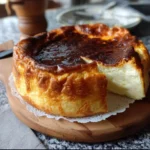
Bake at 400°F (200°C) for 55 to 65 minutes. The cheesecake will puff up significantly, rise above the pan’s rim (held in by the parchment collar), and the top will turn a very deep brown, even appearing black in spots. The edges should be set, but the center will still be extremely jiggly when you gently nudge the pan. It should look like a loosely set pudding in the middle. This is the sign of a perfect Basque Cheesecake. Don’t be afraid of the color—it’s not burnt, it’s caramelized!
Remove the cheesecake from the oven and place it on a wire rack. It will be very puffed up and will sink dramatically as it cools; this is what creates the classic slumped, rustic appearance.
Let it cool completely to room temperature in the pan, which will take about 2-3 hours. Do not rush this step. Once it’s at room temperature, you can serve it for a truly soft, molten-center experience. For a firmer, more traditional (but still incredibly creamy) cheesecake texture, cover it loosely with plastic wrap and transfer it to the refrigerator to chill for at least 4 hours, or preferably overnight.
Nutrition
- Serving Size: One Normal Portion