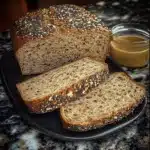
Ingredients
For the Seed Soaker:
- ¼ cup (40g) flax seeds (linseeds)
- ¼ cup (35g) sunflower seeds
- ¼ cup (30g) pumpkin seeds (pepitas)
- 2 tablespoons (20g) sesame seeds
- 2 tablespoons (15g) poppy seeds
- ½ cup (120ml) boiling water
For the Dough:
- 1 ½ cups (360ml) lukewarm water (around 105-115°F or 40-46°C)
- 2 ¼ teaspoons (7g, or 1 standard packet) active dry yeast or instant yeast
- 2 tablespoons (40g) honey or maple syrup
- 2 cups (280g) strong bread flour (high protein flour)
- 1 ½ cups (180g) whole wheat flour
- ½ cup (60g) rye flour (or spelt flour, or more whole wheat/bread flour)
- 2 tablespoons (30ml) olive oil or melted unsalted butter
- 1 ½ teaspoons (9g) fine sea salt
Instructions
1. Prepare the Seed Soaker (Autolyse for Seeds):
In a medium bowl, combine all the seeds for the soaker (flax, sunflower, pumpkin, sesame, poppy). Pour the ½ cup of boiling water over them. Stir well, cover, and let it sit for at least 1 hour, or even overnight in the refrigerator. This step softens the seeds, makes them easier to incorporate, and prevents them from drawing too much moisture from the dough later. Drain any excess water before adding to the dough, though most should be absorbed.
2. Activate the Yeast (Bloom if using Active Dry Yeast):
In a large mixing bowl (or the bowl of your stand mixer), pour in the 1 ½ cups of lukewarm water. Sprinkle the yeast over the water, then stir in the honey or maple syrup. Let it stand for 5-10 minutes until the mixture becomes foamy. This indicates the yeast is active. If using instant yeast, you can skip this specific blooming step and add it directly to the dry ingredients, but blooming with the warm water and sweetener still gives it a good start.
3. Combine Dry Ingredients:
In a separate large bowl, whisk together the bread flour, whole wheat flour, rye flour (or chosen alternative), and salt. This ensures the salt is evenly distributed and doesn’t directly contact the yeast initially, which can inhibit its activity.
4. Mix the Dough:
Once the yeast is foamy, add the olive oil (or melted butter) and the drained seed soaker to the yeast mixture. Stir to combine.
Gradually add the mixed dry ingredients to the wet ingredients. If using a stand mixer, use the dough hook attachment and mix on low speed until a shaggy dough forms. If mixing by hand, use a sturdy wooden spoon or spatula to bring the ingredients together.
5. Knead the Dough:
- By Stand Mixer: Increase the speed to medium-low and knead for 7-10 minutes. The dough should become smooth, elastic, and pull away from the sides of the bowl. It will be slightly tacky due to the whole grains and seeds but shouldn’t be overly sticky. If it’s too wet, add a tablespoon of bread flour at a time. If too dry, a teaspoon of water.
- By Hand: Turn the shaggy dough out onto a lightly floured surface. Knead for 10-15 minutes. Fold the dough over itself, push it away with the heel of your hand, rotate, and repeat. Continue until the dough is smooth, elastic, and passes the “windowpane test” (a small piece can be stretched thin enough to see light through it without tearing easily).
6. First Rise (Bulk Fermentation):
Lightly oil the mixing bowl (or a clean large bowl). Form the kneaded dough into a ball and place it in the oiled bowl, turning it once to coat the entire surface with oil. This prevents a crust from forming.
Cover the bowl tightly with plastic wrap or a damp kitchen towel. Let the dough rise in a warm, draft-free place for 1.5 to 2 hours, or until it has doubled in size. The exact time will depend on the ambient temperature.
7. Shape the Loaf:
Gently punch down the risen dough to release the air. Turn it out onto a lightly floured work surface.
Gently flatten the dough into a rough rectangle. To shape it into a traditional loaf (for a loaf pan):
* Fold the top third of the rectangle down towards the center and press to seal.
* Fold the bottom third up over the first fold and press to seal.
* Rotate the dough 90 degrees. Starting from one of the shorter ends, tightly roll the dough into a log, pinching the seam closed with each turn and at the end. Pinch the ends of the log as well and tuck them slightly under.
Ensure the surface tension is good – the loaf should feel taut.
8. Second Rise (Proofing):
Grease and lightly flour a standard 9×5 inch (23×13 cm) loaf pan. Carefully place the shaped dough, seam-side down, into the prepared pan.
Cover the pan loosely with oiled plastic wrap or a damp kitchen towel. Let it rise again in a warm, draft-free place for 45-75 minutes, or until it has risen about 1-1.5 inches above the rim of the pan and looks puffy. It shouldn’t quite double this time. You can test if it’s ready by gently poking it with a floured finger; if the indentation springs back slowly and leaves a slight mark, it’s ready. If it springs back immediately, it needs more time. If it collapses, it’s over-proofed.
9. Preheat Oven & Prepare for Baking:
About 20-30 minutes before the second rise is complete, preheat your oven to 400°F (200°C). If you have a baking stone, place it in the oven to preheat.
For a crispier crust, you can create steam in your oven. Place an empty metal baking pan (not glass) on the bottom rack of the oven while it preheats. Just before putting the bread in, you’ll pour about 1 cup of hot water into this pan.
10. Score and Bake the Bread:
If desired, brush the top of the loaf very gently with the egg white wash (or spray with water) and sprinkle with the optional topping seeds.
Using a very sharp knife, lame, or clean razor blade, make one decisive slash (about ½ inch deep) down the center of the loaf, or a few diagonal slashes. This allows the bread to expand controllably during baking.
Carefully place the loaf pan into the preheated oven (on the baking stone if using). If creating steam, quickly pour the hot water into the preheated pan on the bottom rack and immediately close the oven door to trap the steam.
Bake for 35-45 minutes. After the first 20 minutes, you can reduce the oven temperature to 375°F (190°C) if the crust is browning too quickly.
The bread is done when it’s deeply golden brown and sounds hollow when tapped on the bottom. For precision, an instant-read thermometer inserted into the center should register 190-210°F (88-99°C).
11. Cool the Bread:
Immediately remove the bread from the loaf pan and transfer it to a wire cooling rack. This is crucial to prevent a soggy bottom and allows air to circulate.
Resist the urge to slice into it right away! Let the bread cool completely, for at least 1-2 hours, before slicing. It’s still cooking internally as it cools, and slicing too early can result in a gummy texture.
Nutrition
- Serving Size: One Normal Portion
- Calories: 190-230