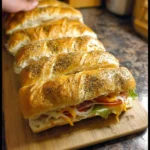
Ingredients
- Warm Water: 1 ½ cups (360ml), heated to 105-115°F (40-46°C). This is crucial for activating the yeast. Too hot, and it will kill the yeast; too cold, and it won’t activate properly.
- Active Dry Yeast: 2 ¼ teaspoons (or 1 standard packet, 7g). You can also use instant yeast; if so, you can often skip the initial proofing step and mix it directly with the dry ingredients.
- Granulated Sugar: 2 tablespoons (30g). This not only feeds the yeast but also adds a subtle sweetness characteristic of Subway bread.
- Bread Flour: 4 ½ cups (approximately 540-560g), plus more for dusting. Bread flour has a higher protein content than all-purpose flour, which helps develop a stronger gluten structure, resulting in a chewier, more elastic crumb – essential for that Subway texture.
- Salt: 1 ½ teaspoons (9g). Salt is vital for flavor and also helps control yeast activity and strengthen gluten.
- Vegetable Oil (or other neutral oil like canola): 3 tablespoons (45ml), plus a little extra for greasing the bowl. Oil contributes to the softness and tenderness of the bread.
- (Optional) Dough Improver or Vital Wheat Gluten: 1 tablespoon. While not strictly necessary if using bread flour, adding a dough improver or vital wheat gluten can enhance the chewiness and rise, especially if you only have all-purpose flour on hand. If using all-purpose flour, vital wheat gluten is highly recommended.
Instructions
1. Activate the Yeast (Proofing):
* In a large mixing bowl (or the bowl of your stand mixer), combine the warm water and granulated sugar. Stir gently to dissolve the sugar.
* Sprinkle the active dry yeast over the surface of the sweetened water.
* Let it sit undisturbed for 5-10 minutes. You should see the mixture become foamy or bubbly. This indicates the yeast is alive and active. If it doesn’t foam, your yeast may be old, or the water might have been too hot/cold. It’s best to start over with fresh yeast.
2. Mix the Dough:
* Once the yeast is foamy, add the vegetable oil and salt to the bowl. Give it a gentle stir.
* Gradually add the bread flour (and vital wheat gluten, if using), one cup at a time, mixing on low speed with the dough hook attachment if using a stand mixer, or with a sturdy wooden spoon if mixing by hand.
* Continue adding flour until a shaggy dough begins to form and pulls away from the sides of the bowl. You might not need all 4 ½ cups, or you might need a fraction more, depending on humidity and your specific flour. The dough should be slightly sticky but manageable.
3. Knead the Dough:
* Stand Mixer Method: Continue to knead with the dough hook on medium-low speed for 7-10 minutes. The dough should become smooth, elastic, and pass the “windowpane test” (you can stretch a small piece thin enough to see light through it without tearing). If the dough is too sticky, add flour one tablespoon at a time. If it’s too dry, add water one teaspoon at a time.
* Hand Kneading Method: Turn the shaggy dough out onto a lightly floured surface. Knead for 10-15 minutes. To knead, fold the dough over itself, then push it away from you with the heel of your hand. Rotate the dough a quarter turn and repeat. Continue this process until the dough is smooth, elastic, and passes the windowpane test. It’s a workout, but very rewarding!
4. First Rise (Bulk Fermentation):
* Lightly grease a large, clean bowl with a little vegetable oil.
* Form the kneaded dough into a ball and place it in the greased bowl, turning it once to coat the entire surface with oil. This prevents a skin from forming.
* Cover the bowl tightly with plastic wrap or a clean, damp kitchen towel.
* Place the bowl in a warm, draft-free place to rise for 1 to 1.5 hours, or until the dough has doubled in size. The ideal temperature is around 75-80°F (24-27°C). If your kitchen is cool, you can place it in an oven with just the light on, or near a preheating (but turned off) oven.
5. Shape the Loaves:
* Once doubled, gently punch down the dough to release the air.
* Turn the dough out onto a very lightly floured surface.
* Divide the dough into two equal portions for classic 12-inch “footlong” style loaves, or four equal portions for 6-inch loaves. Use a kitchen scale for precision if desired.
* Take one portion of dough and gently pat or roll it into a rectangle, roughly 10-11 inches long and 6-7 inches wide for a footlong, or half that for a 6-inch loaf.
* Tightly roll the rectangle up lengthwise, like a jelly roll, pinching the seam firmly to seal. Tuck in the ends slightly for a neater appearance.
* Repeat with the remaining dough portion(s).
6. Second Rise (Proofing):
* Prepare a large baking sheet by lining it with parchment paper or a silicone baking mat. You can sprinkle it very lightly with cornmeal for an authentic touch and to prevent sticking, if desired.
* Carefully place the shaped loaves seam-side down on the prepared baking sheet, leaving at least 3-4 inches between them to allow for expansion.
* Lightly cover the loaves with greased plastic wrap or a clean, dry kitchen towel. Be careful not to let the covering stick to the dough.
* Let the loaves rise in a warm, draft-free place for another 45-60 minutes, or until they have increased in size by about 50-75% and look puffy. When you gently poke the side of a loaf, the indentation should spring back slowly.
7. Preheat Oven and Prepare for Baking:
* About 20 minutes before the second rise is complete, preheat your oven to 375°F (190°C).
* Optional: If you want a slightly crisper crust (though Subway bread is known for its softness), you can place a shallow pan of water on the bottom rack of the oven while it preheats to create steam. Remove it just before baking or be very careful of steam burns. For a soft crust, this step is often skipped.
8. Score and Bake (Optional Scoring):
* Once the loaves are fully proofed, you can optionally score them for a more professional look and to control where the bread expands. Using a very sharp knife, lame, or even a clean razor blade, make 3-4 shallow diagonal slashes (about ¼ inch deep) across the top of each loaf.
* For an extra soft and slightly golden crust, you can lightly brush the tops of the loaves with milk or an egg wash (1 egg beaten with 1 tablespoon of water) before baking. However, classic Subway bread is usually unadorned.
9. Bake the Bread:
* Carefully place the baking sheet with the loaves into the preheated oven on the middle rack.
* Bake for 20-25 minutes for footlongs, or 15-20 minutes for 6-inch loaves. The bread should be golden brown on top and sound hollow when tapped on the bottom. An instant-read thermometer inserted into the center of a loaf should register 190-200°F (88-93°C).
* If the tops are browning too quickly, you can loosely tent them with aluminum foil for the remainder of the baking time.
10. Cool the Bread:
* Immediately transfer the baked loaves from the baking sheet to a wire cooling rack. This is very important, as it allows air to circulate around the bread, preventing the bottoms from becoming soggy.
* Let the bread cool completely (at least 1-2 hours) before slicing. This is the hardest part, as the aroma will be irresistible! Slicing warm bread can result in a gummy texture and can crush the delicate crumb.
Nutrition
- Serving Size: One Normal Portion
- Calories: 520-600